
Introduction
The California State Legislature passed the California Environmental Quality Act (CEQA) in 1970 with the intention of mitigating the environmental harms caused by various types of government projects, including housing development. This was, and remains, an important goal. But over time, the bill developed an unintentional side effect — the often-never-ending delays and uncertainty caused by CEQA review and corresponding litigation became a massive hindrance to housing development, and a major contributing factor to today’s severe housing crisis.
The Legislature eventually responded to this problem through careful legislative effort, most notably culminating in AB 130 last year, which effectively ended CEQA stonewalling for most urban infill development. But with the days of never-ending CEQA reviews coming to a close, and with the passage of other pro-housing legislation like the Housing Crisis Act of 2019 and SB 79, anti-housing (NIMBY) advocates have been left with fewer and fewer ways to block California’s much-needed housing development.
Now, however, some California jurisdictions are making eyebrow-raising adjustments to their fire regulations. There is reason to believe that the NIMBY/YIMBY battleground is shifting: from environmental review to fire safety.
Just as environmental protection was an important goal motivating CEQA, fire safety is also important — especially in a time when climate change is increasing the risk of wildfires. But California legislators should learn the lessons of CEQA and ensure fire safety regulation is written with careful consideration of its broader ramifications on urban planning, and doesn’t unintentionally become the cause of a renewed housing crisis.
How Fire Regulation Slows Development
There are two broad categories of fire risk that affect housing development: fire risk from the environment (i.e. wildfires), and the general fire risk that arises from ordinary human activity. Environmental fire risk is very location-dependent – it tends to raise questions about whether (and what kinds of) housing development is suitable for the location at all. General fire risk is less about location and more about overall fire safety best practices. When it comes to general fire risk, the questions we ask are rarely about whether housing development should happen in the area, but how to ensure that the buildings that are constructed are safe and resilient.
While these two categories aren’t fully distinct — for example, evacuation is a key consideration when managing both types of risk, and general fire safety practices often help shape environmental risk — it is helpful to think about the two types of fire risk separately, because the way cities address them can have very different implications for housing development and urban planning.
Environmental Fire Risk
In order to prepare for and mitigate the risks of wildfires, the California State Fire Marshal is required to classify state lands into Fire Hazard Severity Zones (FHSZs)[1]. These zones (which are classified as either Moderate, High, or Very High severity) are used by the Fire Marshal to establish specialized construction standards for building in locations with high wildfire risk. They are also used by local governments to develop their own standards for wildfire prevention.
How fire hazard severity zone designations can be used to suppress housing development
One of the most important lessons from CEQA is that harm-mitigation legislation should be context-aware. Before AB 130, the CEQA review process was often as burdensome for infill housing development in urban centers as it was for greenfield development on far-flung sites. This doesn’t make sense from a harm-mitigation perspective, because infill urban housing causes far less new net harm to the environment than greenfield sprawl. Yet the majority of CEQA litigation was used to delay or block infill projects, not greenfield projects, and high-density urban housing was targeted more than any other type of housing. This incentivized developers to build further afield, where there would be less local opposition, even if it meant greater environmental harm. In this respect, CEQA unintentionally exacerbated environmental harm rather than reducing it.
The same pattern is beginning to play out with FHSZs. The purpose of FHSZ designations is to enhance safety in areas with high wildfire risk. Used thoughtfully, they are a valuable tool in ensuring that safe construction standards are applied across all of California’s varied geographies. But if legislators are not careful, FHSZs can be used to suppress housing in urban centers and encourage further wildland sprawl.
Many of California’s pro-housing laws currently include FHSZ carveouts that are susceptible to this problem. For example, SB 79, a recent bill that allows multi-family housing development near transit stops, has a carveout for sites within areas classified as Very High FHSZs[2], allowing cities to exempt parcels within those zones until the early 2030s[3]. Similarly, the Affordable Housing and High Road Jobs Act of 2022 (AB 2011), which creates a streamlined approval process for affordable housing developments exclusively in urban commercial zones, does not apply to development on vacant lots within areas classified as Very High FHSZs[4]. These carveouts weaken the legislation’s impact, suppressing housing availability in precisely the urban centers they are designed to support.
Excluding FHSZs from pro-multifamily-development legislation can also, paradoxically, increase overall fire risk. Recent research shows that modern multifamily housing is dramatically more fire-safe than single-family housing, due in large part to more stringent safety standards imposed on multifamily construction, including the use of fire-safe materials, sprinklers, and compartmentation. Unfortunately, when multifamily development is barred in FHSZs, the alternative is more single-family homes in those same FHSZs, plus more sprawl into even more hazardous lands. The share of single-family homes developed in FHSZs has been climbing in recent years, even as safer multifamily homes are obstructed. And as a recent UC Irvine study discovered, “the growing tendency of people to build homes in the wildland-urban interface, near the source of forest fires, has resulted in significant property damage.”
The problem is not the FHSZ designations themselves. It is crucially important that we identify areas where extra care must be taken to mitigate fire risk. But legislators should be careful that these zones do not become, like CEQA, a backdoor tool for NIMBYs to prevent the development of multifamily housing in urban areas.
Already, there is evidence that this strategy is developing.
While the State Fire Marshal provides its FHSZ classifications as recommendations to local governments, it is ultimately the responsibility of local governments to codify their own FHSZ classifications for areas within their jurisdiction in a local ordinance[5].
This gives local governments a surprising amount of power over FHSZ designations. Local governments may not decrease an area’s FHSZ severity level below what the State Fire Marshal has recommended, but they have discretion to increase the FHSZ of any area within their jurisdiction[6]. And although the Fire Marshal must base its FHSZ recommendations on consistent statewide criteria, local governments have latitude to determine their own standards for Very High FHSZ classification[7]. And they can upgrade any area into a High or Moderate FHSZ without making any findings at all. These lower classifications can be fully arbitrary or even politically-motivated.
With CEQA stonewalling curtailed, there are signs that the local expansion of FHSZs may become a new NIMBY/YIMBY battleground. For example, San Diego has expanded their FHSZs to cover the vast majority of the city’s land – a far greater area than what is covered by the State Fire Marshal’s recommendations. Additionally, they have upgraded all of these lands into Very High FHSZs, dropping the Moderate and High classifications entirely.
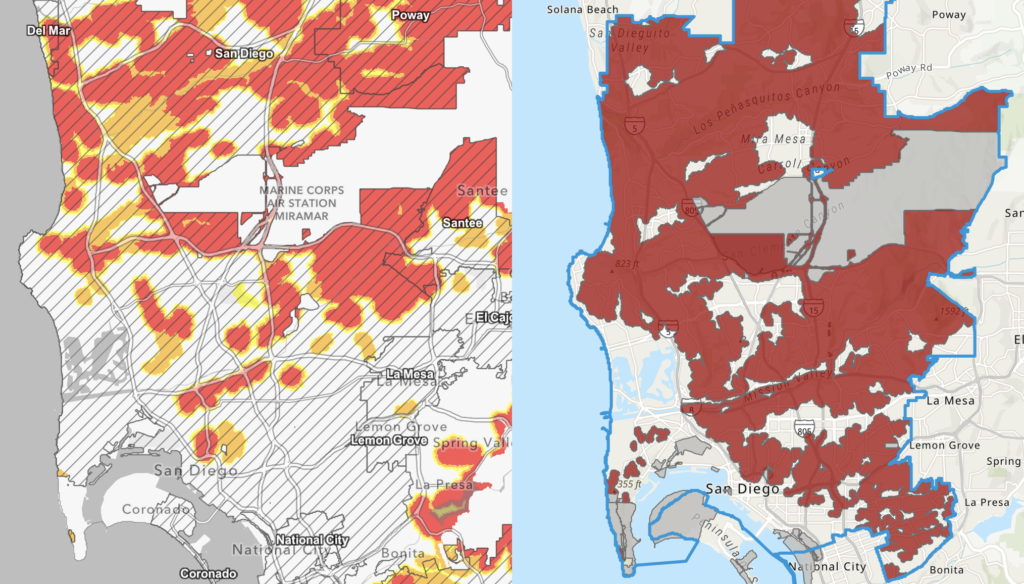
After creating these heavily-expanded FHSZs, San Diego’s City Planning Department used them to declare temporary exemptions[8] for parcels covering more than 25% of the development area that would have otherwise been subject to SB 79’s pro-housing requirements. This is more than five times the amount of area the State Fire Marshal’s maps would have allowed them to exempt.
FHSZ designations should be a tool for enhancing fire safety, not a tool for blocking housing development. But current FHSZ law allows San Diego’s government to exempt much of its urban land from the reach of pro-housing legislation like SB 79 and AB 2011. San Diego is not unique in this practice, and it is likely to become more widespread as long as NIMBY proponents can use it as a method to reduce the development of affordable housing.
How to prevent fire hazard zone designations from creating housing shortages
There are a few steps that State legislators can take to prevent FHSZs from interfering with much-needed housing development in California.
First, the State Fire Marshal should clearly state the safety standards that apply to multifamily housing development in urban FHSZs. The Fire Marshal’s explicit safety recommendations for FHSZs are generally targeted towards single-family homes. And the State’s posture towards these single-family homes is to prioritize safety and mitigation measures rather than banning their development, even though these homes often carry far higher wildfire risk than urban multifamily development. The State should adopt the same posture towards urban multifamily homes. Rather than blocking development altogether, the State should rely on the Fire Marshal to introduce safety requirements and fire-resilient construction standards that ensure these homes are built safely.
Second, State pro-housing legislation should rely solely on the Fire Marshal’s FHSZ classifications, not the expanded classifications determined by local jurisdictions. Many pro-housing laws are ambiguous about which classifications they rely on, and local jurisdictions like San Diego take advantage of this ambiguity to exempt large portions of their land area from the scope of the pro-housing legislation. Local jurisdictions should retain the ability to set their own policy based on their own determinations of area wildfire risk, but they should not have the power to change the way State housing law applies to them. The State Fire Marshal is much better suited to make the sort of big-picture, non-political fire safety decisions that State housing law should rely upon.
Finally, legislators should take care before including carveouts for FHSZs in pro-housing legislation, and should consider removing these carveouts from some existing pro-housing statutes. Alternatively, the carveouts should require appropriate fire hazard mitigation steps to be taken, rather than excluding the sites altogether.[9] As noted above, when legislators prevent urban multifamily housing development in FHSZs, they unintentionally contribute to housing sprawl into higher-risk areas, increasing rather than decreasing the overall risk of property damage due to wildfires. Additionally, stringent building and landscape-hardening standards can mitigate the risks involved with building in FHSZs. Giving up on pro-housing legislation altogether in these areas is often an over-correction, and it opens up a new avenue of obstruction for NIMBYs who are desperate for new loopholes to exploit.
General Fire Risk
In addition to managing wildfire risk through Fire Hazard Severity Zones, the State Fire Marshal is responsible for developing and updating a set of minimum standards for building fire safety[10]. This set of standards is known as the California Fire Code (CFC). The California Fire Code is adapted from the International Fire Code (IFC), a model code produced by the International Code Council, which is a private non-profit organization sponsored by the building trades[11].
The California Fire Code is one of the strictest fire codes in America. And yet, as with FHSZs, some local jurisdictions take advantage of their discretion to implement even stricter codes that at times thwart the intentions of California’s pro-housing legislation.
How discretionary local fire codes can be used to suppress housing development
As with FHSZs, local governments may impose fire safety standards of their own as long as those standards are more, not less, stringent than those found in the CFC[12].
Notably, AB 130 — the CEQA reform bill — placed a temporary moratorium on most new local building standards that impact housing, except in the case of an emergency[13]. But that provision expires on June 1, 2031. In the meantime, legislators should be aware of the impact that local adjustments to fire codes can have, and already have had, in suppressing housing development.
There is good reason for local governments to be allowed flexibility in their local fire regulations. California is one of the most diverse states in the nation by many metrics — including geography, topography, and population — and that diversity can lead to unique safety conditions that cannot be fully addressed by a uniform statewide code.
But there are some types of flexibility that are counter-productive to housing development.
First, fire safety standards can be so strict that they make certain kinds of state-approved housing development infeasible. For example, the State Legislature passed a pair of bills (AB 2299 and SB 1069) in 2016 to make it easier for homeowners to build accessory dwelling units (ADUs) on their existing property, in part by restricting local governments’ ability to preclude this construction through zoning. In 2022, Los Altos Hills quietly passed an amendment to their local fire code that included fire access road requirements for ADUs that are significantly more stringent than those in the CFC. This effectively made ADUs on many lots infeasible, even as they were technically allowed by zoning. Similarly, a 75-unit affordable housing development proposal in Burbank was slashed to 11 units by the City Development Director, in large part because of a local fire access road requirement that is significantly more stringent than the CFC. This is a concerning precedent, and a blueprint for how NIMBY advocates can use local fire code to thwart State legislation.
Second, overly strict safety standards can be a backdoor for subjective standards that are prone to abuse. When a project cannot meet the standards set by a local fire code, its developer can file an Alternate Means and Methods Request (AMMR) to the local fire authority, who has discretion to grant a non-precedential exception to any safety standard if the developer can provide a sufficient alternative safety plan. When the standards regularly make projects infeasible, this gives the local fire authority enormous discretionary power — they can decide which AMMRs to accept or deny on a near-arbitrary basis. This creates an avenue for politically-motivated project approvals and denials, which is exactly what State legislators intended to stamp out with pro-housing legislation like the Housing Accountability Act. The developer of the Burbank project referenced above submitted an alternative safety plan to save the 75-unit proposal, but was unsurprisingly denied.
Additionally, the use of fire safety regulation as a political means of restricting housing development shifts the fire code away from its critically-important goal — ensuring homes are safe from fire risks.
How to prevent the politicization of discretionary fire codes
Fortunately, there are sensible regulations that State legislators can pass that would retain local flexibility in fire safety standards, while preventing that flexibility from being used as a tool to interfere with housing development.
Require State approval of new provisions in local fire codes that would impact housing development. AB 130’s temporary moratorium on new fire code provisions that impact housing cannot and should not extend forever. Local governments should regain flexibility to protect their communities from risks that are unique to their communities. But that flexibility should come with oversight. Local jurisdictions should be required to submit proposed amendments that would impact housing to the State Fire Marshal and the State Department of Housing and Community Development for approval, and both agencies should be willing to reject any plan that would thwart the State’s interest in addressing the housing crisis while maintaining fire safety.
Require objective standards for AMMRs. Local fire authorities should be required to provide objective standards for approving or denying AMMRs, so that the AMMR approval process cannot be easily politicized. Alternatively, AMMRs denials should be subject to review by the State Fire Marshal.
Require the fire code compliance stage to occur after project approval. In most jurisdictions, fire code compliance occurs after the project has already been approved by the city council. But some jurisdictions, like Los Altos Hills, have moved the fire code compliance stage into the pre-approval entitlement phase. This politicizes the local fire authority’s sign-off by allowing it to be used as a bargaining chip in the often-heavily-controversial project approval discussions. By requiring the fire code compliance stage to occur after the project has already been approved, State legislators can ensure that fire authority’s role in the development process remains procedural and not political.
Finally, until all of these safety measures are implemented, AB 130’s temporary moratorium should be extended. AB 130 provided a period of temporary shelter, during which local governments cannot implement new fire code provisions to stymie housing development. But in 2031, that shelter will end, and NIMBY advocates will likely begin to push for questionable fire code amendments. If state legislators cannot implement sensible reform to local control of fire safety before then, they should simply extend the clock until they can.
Conclusion
Allowing fire safety to be politicized leads to wildland sprawl, subjective standards, a worse housing crisis, and ultimately less fire safety. If California legislators have truly learned the lessons of CEQA, they will not let fire safety regulation become a tool for those who want to suppress housing development.
There is no more justification for a conflict between fire safety regulation and housing development than there was for a conflict between housing development and CEQA’s protections against environmental harm. But if legislators leave fire safety open to misuse by NIMBY advocates, we will almost certainly soon find ourselves in the midst of another affordable housing war. State legislators should step in with careful legislation, before the situation has the opportunity to get any worse.
Obasi Shaw is a Summer Legal Intern at CalHDF, and a current JD/PhD student at Stanford.
[1] PRC 4201-4204, Gov Code 51178
[2] Gov Code 65912.161(a)(2)(A), (b)(1)(D)
[3] Specifically, one year into the seventh housing element cycle, which varies by jurisdiction. Id. at (b)(1).
[4] Gov Code 65912.111(h)(2); Gov Code 65912.121(j)(2)
[5] Gov Code 51179(a)
[6] Id. at (b)(3)
[7] Id. at (b)(1), Gov Code 51182(f)(1)
[8] These exemptions last until one year into the seventh housing element cycle, which is 2030 in San Diego.
[9] This is the approach taken by SB 35 (2017). That law’s carveout for Very High FHSVs only applies to projects if they don’t take appropriate mitigation steps: “This subparagraph does not apply to . . . sites that have adopted fire hazard mitigation measures pursuant to existing building standards or state fire mitigation measures applicable to the development.” (Gov Code 69513.4(a)(6)(D)).
[10] HSC 13143 – 13143.9
[11] https://www.iccsafe.org/about/sponsors/
[12] HSC 13869.7
[13] HSC 18941.5