
In the last few weeks, CalHDF has taken our litigation efforts to the California Court of Appeal in two cases that would have statewide impacts. In California, published decisions from the appellate courts are binding precedent on trial courts throughout the state, meaning that lower courts would need to follow the ruling in both of these cases for all future decisions. We hope to win both cases and advance state housing laws to pave the way for future housing growth.
1000 Friends Protecting Historic Benicia v. City of Benicia
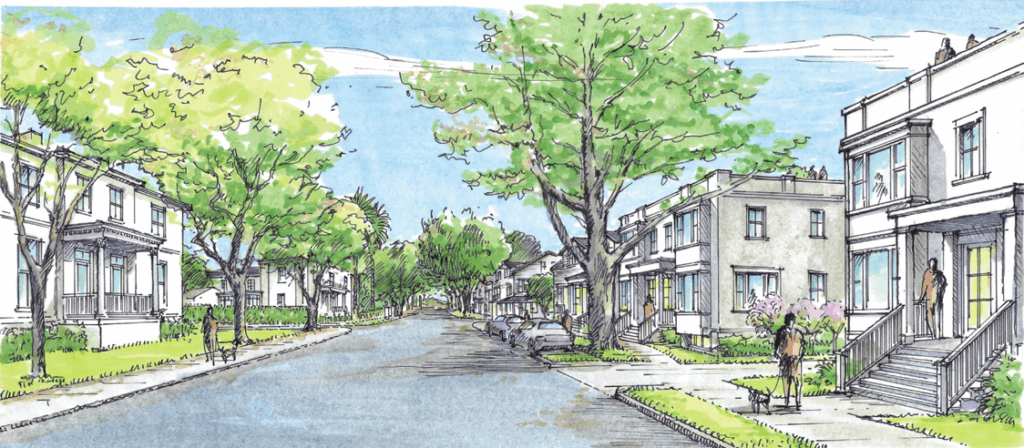
CalHDF is known for suing cities that break housing laws, but in this case we are helping to defend a lawsuit where the city did the right thing by approving two housing developments. The developments in question were proposed back in 2021, and would be located on two parcels in the Arsenal Historic District in Benicia. The developments sought streamlined ministerial approval under Senate Bill 35, one of the first YIMBY-supported laws enacted to expedite the approval of affordable housing. After some disagreement over the application of subjective historic design standards, the CIty approved both projects in 2022. Like many other developments around California, a local NIMBY group raised money to fund a lawsuit challenging the approvals under the California Environmental Quality Act (“CEQA”). The lawsuit had little merit, but merely being willing to challenge housing in court can delay a project for years, no matter how frivolous the arguments are.
Now, three years later, the group has lost their case in the trial court, but they appealed the decision to the Court of Appeal. Because of the costs and extensive delays due to the litigation, the viability of both projects was in danger. CalHDF stepped in to represent one of the developers, ensuring that the projects were not effectively denied due to the delays imposed by the litigation.
At issue in the case is whether ministerial projects are subject to CEQA lawsuits and whether the projects qualify for ministerial approval under SB 35. Each project should be entirely exempt from CEQA due to the ministerial nature of the permits, but the appellants argue that the City should nevertheless have offered local groups the opportunity to appeal the exemption. This issue is critically important, because the intent behind granting ministerial approval to housing is to shield approvals from the delays and costs that come with CEQA litigation. A victory in the Court of Appeal will set precedent shielding future ministerial projects from litigation risks. It will also protect projects subject to other statutory exemptions from CEQA lawsuits, like the new infill housing exemption enacted as part of the state budget over the summer (AB 130).
Read the entire brief here.
CaRLA v. County of Santa Clara
This case took so long to get a decision from the trial court that it is our last case left filed under our previous name (California Renters Legal Advocacy & Education Fund, or CaRLA for short). In this case we challenged a small localized downzoning of a wealthy single-family neighborhood near Stanford University in unincorporated Santa Clara County. This was the classic NIMBY downzoning. After one of the larger lots in the neighborhood was divided into a small-lot subdivision development for teacher housing, neighborhood activists banded together to lobby the county to prevent any future subdivisions and preserve the large-lot character of the area. The County responded, proposing and enacting zoning changes that increased setback requirements, decreased lot coverage limits, and instituted a minimum lot frontage requirement to ensure that the large lots could not be subdivided into smaller, more affordable single-family lots.
Fortunately, the legislature had recently enacted the Housing Crisis Act of 2019 (aka SB 330). The newly enacted law prohibited affected local governments from downzoning or otherwise reducing the development intensity, defined as “including . . . new or increased setback requirements, minimum frontage requirements, or maximum lot coverage limitations . . . .” The state had already outlawed exactly the things that Santa Clara did in its neighborhood rezoning effort! We sued to challenge the ordinance. After waiting for over a year, the trial court ruled against us.
On appeal, we hope to establish that local governments must obey the plain meaning of SB 330, and not take any actions that reduce the development intensity. We also hope to establish that housing orgs have standing to sue to enforce the provisions of SB 330. Our housing crisis is partially the result of decades of small zoning changes like this one that have accumulated to rob the state of potential housing growth. CalHDF is dedicated to stopping this slow death by 1000 NIMBY cuts and ensure that we have the potential to build the housing we need for the future.
Read the entire Appellants Opening Brief here.