
Summary
Housing elements are required portions of every local government’s general plan, developed and enacted with the purpose of accommodating housing growth for households at all income levels. Los Altos Hills, a wealthy town in Silicon Valley, was facing a deadline to establish zoning for multifamily housing, and was confronted with several potential mixed income developments, which would have been the first of their kind in the Town. Instead of embracing the needed housing growth, the Town revised its plan to ensure that no new housing would get developed. This new plan violated state Housing Element Law and its own housing element by enacting new barriers to multifamily development and attempting to change its housing element in a way that fails to comply with state Housing Element Law, Fair Housing Law, and the Town’s Affirmatively Furthering Fair Housing (AFFH) duty. Instead of adopting rezonings to facilitate affordable housing development as promised in its 2023 housing element, the Town reduced the size of its viable housing sites and restricted the zoning on the remaining sites to ensure that no feasible development options were available.. The Town adopted these changes in direct response to proposed developments on one of its listed sites, undermining the only viable opportunities for moderate- and lower-income housing in one of California’s most exclusionary communities. Somehow, the state Department of Housing and Community Development approved the plan, leaving CalHDF as the only challenger to ensure the purpose of housing element law is realized in one of the state’s more exclusionary communities.
Background on Los Altos Hills
Located in the heart of Silicon Valley, Los Altos Hills is one of the wealthiest cities in the country. Its median home price is more than $6 million, almost eight times the California median home price, and its housing stock is 97% single-family homes. Black and Latino residents make up a combined 4.4% of the city’s population, in contrast to over 47% statewide. The city is entirely designated a Racially or Ethnically Concentrated Area of Affluence.
California’s fair housing law is clear that municipalities like Los Altos Hills, where exclusionary single-family zoning has kept out lower-income families and people of color for decades, have an affirmative duty to further fair housing (AFFH) and expand housing opportunity. The City’s own housing element acknowledges that the primary fair housing issue in Los Altos Hills is the lack of multifamily housing, and commits to policies that encourage it. The rezoning and changes to the housing element do the opposite.
The 2023 Housing Element
The Town’s Regional Housing Needs Allocation (RHNA) requires it to plan for at least 489 new housing units by the end of this planning cycle in 2031, including 197 lower-income units. The Town has no deed-restricted affordable housing, and only 16 of its 3,180 housing units are multifamily units.
The Town’s 2023 housing element was certified by the California Department of Housing and Community Development (HCD) in May 2023, and acknowledged that existing zoning was insufficient for accommodating the Town’s RHNA. Therefore, the 2023 housing element committed the Town to rezoning three sites by January 2031:
- Twin Oaks – Covering 15 acres and seven parcels on Twin Oaks Court and Arastradero Road.
- Foothill College – approximately 14.5 acres on its campus.
- St Nicholas Catholic School – at least 5 acres on its campus.
These three sites were the only mechanism offered by the 2023 housing element for producing lower-income, deed-restricted housing.
The Rezoning and Housing Element Amendment
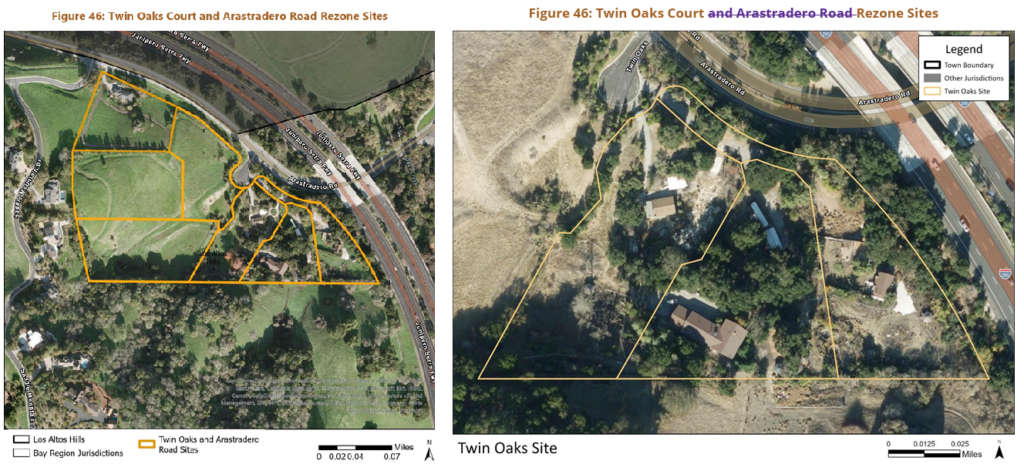
In February 2025, almost two years after HCD certified the 2023 housing element, a developer submitted a preliminary application for a mixed-income, multifamily development on the Twin Oaks site, which would have been the first deed-restricted affordable housing in the Town’s history. Rather than process the application, Town officials gave in to community pressure to preserve the Town’s “character” by amending the housing element to thwart the development. The Town immediately moved to initiate a housing element amendment and rezoning to block the development and simultaneously delayed the application by repeatedly asserting that it was incomplete.
In December 2025, the Town enacted Ordinance 621, which fell far short of its 2023 housing element commitments. It rezoned only three of the seven Twin Oaks parcels, which are already occupied by homes and removed the Arastradero Road parcel, despite, or rather, because of its owner’s repeated interest in developing affordable housing. The Town did not rezone the Foothill College site at all but instead imposed a “Floating Multi-Family Overlay” on it that provided a mechanism to rezone the unspecified site on the campus in the future. The St. Nicholas Site received an overlay that expressly permits continued school use without any residential component, violating minimum density laws prescribed by state law and reinforced by case law.
Ordinance 621 capped density at these sites at 24 dwelling units per “contiguous building acre” rather than the 30 du/ac promised by the 2023 housing element. The Town also imposed highly restrictive development standards never analyzed in either version of the housing element, including setbacks, minimum lot sizes, and unit size caps.
On February 2, 2026, the Town adopted an amended housing element designed to retroactively justify the rezoning in Ordinance 621. The 2026 housing element amendment relies on the same three sites at the same projected units as in the 2023 housing element without analyzing how the site reductions and new constraints undermine those projections. The amendment claims that Foothill College and St. Nicholas have expressed “continued interest” in housing development, a claim flatly contradicted by the Town’s own mayor, who admitted publicly in November 2025 that “Foothill College has publicly declared that they will not be building any affordable housing there,” and that “St. Nicholas School has gone on record to say that they will not be building anything there. The Diocese of San José sent multiple letters, most recently in October 2025, to the Town stating its intention not to develop the parcel and its desire for the parcel not to be rezoned under the housing amendment.” Similarly, instead of developing on-site student housing, Foothill College purchased property in Mountain View for housing. As for the Twin Oaks site, the owners of the parcels that remain in the site (after it was reduced in size by housing element amendment and rezoning) stated in December 2025 that development of those lots is “not a feasible development” due to existing single-family homes on the properties.
CalHDF submitted four written comment letters between September 2025 and February 2026 identifying these violations and urging the Town to comply with state law, but the Town declined each time. The Town’s attempt to block the Twin Oaks development application follows a pattern of two earlier denials of Builder’s Remedy affordable housing projects.
Timeline
- Early 2023: the Town denies two Builder’s Remedy affordable housing projects on manufactured procedural grounds
- May 2023: HCD certifies the Town’s 2023 housing element
- February 20, 2025: a developer submits a preliminary application for the Twin Oaks development, leading the Town to initiate a rezoning and housing element amendment at the same meeting
- September-December 2025: CalHDF submits three comment letters opposing the proposed rezoning and housing element amendment
- October 10, 2025: HCD finds the draft housing element amendment legally deficient
- November 17, 2025: the Town’s mayor publicly admits Foothill College and St. Nicholas will not develop housing on their sites
- December 9, 2025: the Town adopts Ordinance 621 rezoning
- February 2, 2026: CalHDF submits the final comment letter, and the Town adopts the 2026 housing element amendment
- February 10, 2026: HCD certifies the amendment but flags unit size and setback standards for modification
- April 9, 2026: CalHDF files suit in Santa Clara County Superior Court